No 464 Squadron (464SQN) was formed on 1 September 1942 at Royal Air Force (RAF) Feltwell in East Anglia, England, under Article XV of the Empire Air Training Scheme (see the documentary: An Enduring Legacy: The Empire Air Training Scheme | Air Force). Initially equipped with Lockheed Ventura light bombers, it was part of No 2 (Bombing) Group in RAF Bomber Command.
In mid-1943, 464SQN was moved under No 140 Wing (140WG) RAF and subsequently re-equipped with the famous de Havilland Mosquito fighter-bomber. 140WG, which also contained two other Mosquito units – No 487 Squadron Royal New Zealand Air Force and No 21 Squadron RAF, was part of the RAF’s Second Tactical Air Force within Fighter Command. 464SQN provided a fast, responsive tactical air element to the battlefield. Instead of the usual 30 missions required of Bomber Command aircrews, a 464SQN tour for aircrew involved 50 operational missions.
With the war in Europe over on 8 May 1945, 464SQN was disbanded on 27 September 1945, having undertaken more than 3000 sorties and attacked more than 2300 targets during the war. One hundred and eleven members of 464SQN lost their lives in the Second World War.
464SQN was re-formed on 1 January 2021 as the RAAF’s public affairs and media unit, and is part of Air Force Headquarters Chief of Staff Branch. The unit is focused on consolidating the Air Force’s Strategic Communications and Military Public Affairs (MPA) capabilities. MPA is the provision of public information and management of media access to inform, educate and persuade broad target audiences about Defence and its activities. 464SQN Headquarters element is located at HMAS Harman in Canberra, with Public Affairs Officers (PAO) and Air Force Imagery Specialists (AFIS) operating across the country.
Gathered here are some of our 464SQN stories compiled as part of History and Heritage – Air Force’s Living History Program.
Leading Aircraftwoman Nell Bradbury
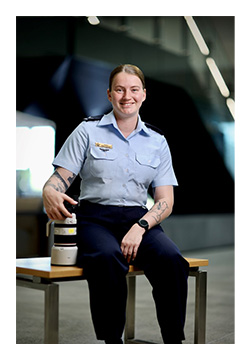
I am an AFIS with 464SQN. My motivation to join the Air Force began at university. In my first year of studying, I completed a photo journalism subject I really enjoyed but, at the time, I thought I would pursue a career as an artist. It wasn’t until my third year, while researching photographers from the Second World War, that my perspective changed. Discovering the work of George Silk made me wonder whether that kind of role still existed, and it turns out that it does.
To explore whether Air Force was the right fit for me, I attended several ‘Women in Defence’ sessions and spoke with people who had experience in the ADF. I also have family connections to Defence and, after a conversation with a close friend who has served in the Army for many years, I decided to apply. From that moment, what began as an idea quickly became my day to day reality.
There is always room to develop and strive for more in this job, which is something that really motivates me. I’ve recently returned from Exercise Red Flag in the US, and experiences like that highlight just how unique and rewarding this career can be.
Learning more about 464SQN’s history has been deeply meaningful.
Squadron Leader Shaun Donnelly
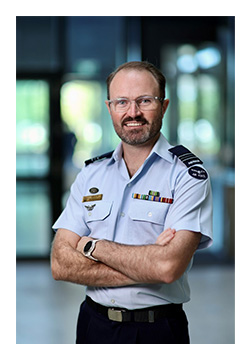
I am the Executive Officer of 464SQN, working alongside the CO as second-in-charge. My role is focused on the internal coordination of the squadron: ensuring our priorities align with higher direction and that our activities are balanced to meet the mission we are tasked to achieve. While the CO manages outward-facing responsibilities and engagement up the chain of command, my focus is very much on the people and processes within the squadron, making sure we are set up to succeed.
By bringing together photographers, videographers and PAOs, we are able to inform the Australian public about what their Air Force is doing and why it matters. Maintaining that connection and trust is an important duty.Reflecting on the squadron’s history has been particularly meaningful.
Learning about the scale of operations during the Second World War, and the crews, such as Justin Mulligan and Billy Kinloch who flew mission after mission together, really brought home the legacy we carry today. While technology has changed, the fundamentals remain the same: small teams, limited guidance, and a strong reliance on precision and intent.
For 464SQN now, we have a responsibility to continue to foster the trusted and respected relationship between Australians and their Air Force.
Leading Aircraftwoman Mikaela Fernlund
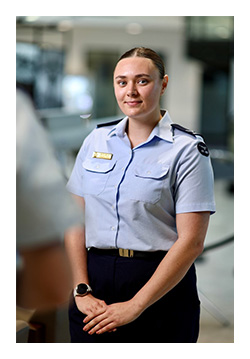
Winner of the Best Official Air Force Photograph, 2025 (SQNLDR W.T. Riggs Trophy)
I was motivated to join the Air Force because I wanted something challenging and different, and to be surrounded by likeminded people who seek opportunities and push themselves every day. The work we do is important, and I am incredibly glad I chose this career path.
I am an AFIS, capturing still photography across a wide range of activities. My role includes everything from group photos and portraits to public affairs missions, exercises, aircraft operations and interoperability activities. Each tasking tells a story, and every job – whether at home or overseas – plays an important part.
One of my favourite images was taken in preparation for the Richmond Air Show. I had the opportunity to ‘ramp ride’ on a C 130J Hercules and capture photographs of an F 35 flying behind us. It was an incredible moment and a reminder of how unique and rewarding this role can be.
Serving Australia through imagery is a privilege, and being able to help preserve and share these stories is something I am truly proud of.
Warrant Officer Ricky Fuller
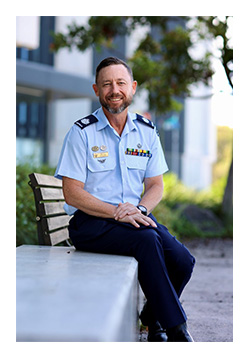
My family has a lot of service connections and, as a kid, I was interested in photography. So when a cousin of mine, who was in the RAAF, suggested a career as a RAAF photographer, I decided to apply because it offered me the chance to get paid to learn what I wanted to do. I joined in 1996 and after recruit training in Adelaide, I went to RAAF Base East Sale (Vic) to do my photography training for nine months. Since then, I’ve had lots of interesting postings, including three postings to RAAF Base Richmond, Canberra, and RAAF Base Williamtown. I have also had the opportunity to deploy overseas many times, including with the Army.
One of the coolest jobs I've ever got to do was a flight down to Antarctica. We ended up being there for three hours and it was a great experience. It's something that not many people get the opportunity to do. I’ve also had the honour of being the Squadron WOFF, and being the head photographer for the trade.
It made a big difference to RAAF photographers when 464SQN was re-established as an MPA unit in 2021 because it created a ‘home’ for our trade. On top of that, we are fortunate to have inherited the rich history of the wartime 464SQN.
Sergeant Kylie Gibson
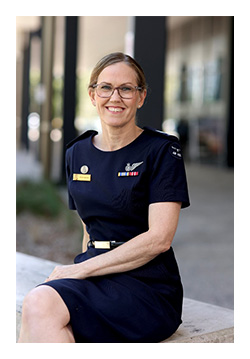
I’m what they call a ‘RAAF brat’. My dad was a supply WOFF and my mum was in the Women's Royal Australian Air Force and that’s how they met. After leaving school, I was a teaching aide and art student, but decided I wanted a good stable career and decided to enlist in the Air Force. I’ve always had an interest in art and when I saw a recruiting ad for RAAF photographers, I decided to pursue that as a career.
I’ve had the opportunity to do a lot of travel as an Air Force photographer, which has been amazing. I re-mustered to crew attendant in 2013 and flew with No 33 Squadron for five years before reverting to being an AFIS in 2018 and, in 2021, was posted to 464SQN. I’ve had some great experiences, including on Exercise Indo–Pacific Endeavour where I had the opportunity to work with international partners and the Army. For the past three years, I have been an instructor on the ADF imagery specialist course, teaching our new photographers, which has been really rewarding. I tell people we've probably got the most exciting and versatile job because we get to see people in all kinds of Air Force roles, doing their jobs.
Hearing the story of Justin Mulligan and Billy Kinloch reinforced to me the serious side of military service. It was quite emotional to commemorate these two Second World War aviators, and it was really nice to meet their families.
Flight Lieutenant Rob Hodgson
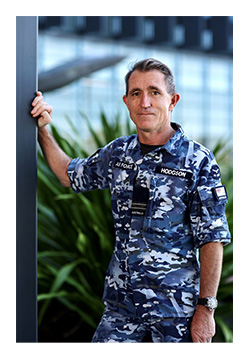
This is my second career. Before joining the Air Force, I spent 20 years working at the ABC as a television producer, primarily on Australian Story. Even then, Air Force was always in the back of my mind. My father was career Air Force, as was my grandfather. I was born at East Sale in Vic, so blue has always been in my blood. Eventually, the timing felt right to make the change. I learned about the need for specialist reserve PAOs, applied and, since joining, I’ve been on continuous fulltime service, which has effectively placed me in the permanent Air Force.
No two days are ever the same. I’ve been involved in operations, humanitarian assistance and disaster relief, as well as exercises, which are very much our bread and butter. I’ve deployed overseas and travelled to almost every state in Australia with Air Force, and I’ve been fortunate to see and do things I never imagined I’d see and do. What really stands out is the sense of purpose and doing exactly what I joined to do: serving my country and supporting our neighbours and allies.
The story of Justin Mulligan and Billy Kinloch reinforced to me the importance of recognising service and the strong link between the past and the present. connection to history, and the pride that comes with wearing the blue uniform, is something I carry with me every day.
Leading Aircraftman Campbell Latch
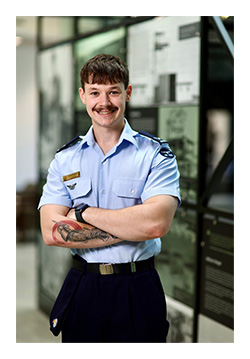
Originally, I wanted to go to university to study military history. However, high school, for me, landed in peak COVID times, so I decided to pursue a career with the RAAF, which led me to being an AFIS in 464SQN. I did a little bit of photography in high school but when I did my training in the RAAF, I realised there was a lot more to photography than point and shoot! The training and instructors were very high quality and I feel privileged to have been given that opportunity.
I’ve had lots of great experiences in the RAAF, such as riding the ramp of an aircraft flying over the red sands of central Australia, and delivering assistance to an orphanage in Timor Leste. No two days are ever the same.
What really struck me about the story of Justin Mulligan and Billy Kinloch was they were the same age as I am now, 22, when they died on air operations during the Second World War. It was really inspiring to hear about how many dangerous operations they conducted, and the things they would have experienced at the same age as myself. And to hear a recording from 1943 of Justin Mulligan sending a message to his family back home was both interesting and emotional.
About Justin Mulligan and William Kinloch
Justin Reginald Mulligan – known as ‘Joe’ – was born on 22 August 1922 in Guyra, south of Inverell in northeast New South Wales (NSW). He grew up on his family’s farm and was a wool classer prior to enlisting in the RAAF in June 1942, aged 19, with service number 423164.
William Albert Kinloch – known as ‘Billy’ – was born at Leeton in country NSW on 16 November 1922. After leaving school, Billy worked in the family hardware business in Leeton until April 1942 when, aged 19, he enlisted in the RAAF with service number 421988.
Joe, a pilot, and Billy, a navigator/observer, met at No 34 Operational Training Unit at Pennfield Ridge, New Brunswick, Canada, in July 1943 where they underwent conversion to the Ventura bomber. They then did conversion training in the United Kingdom on the de Havilland Mosquito before being posted to 464SQN at Thorney Island in Sussex. Joe and Billy flew 62 operational missions with 464SQN and were killed in action on air operations over Germany on 13 January 1945. Both were posthumously awarded the Commendation for Gallantry in 2024.
Read more about Joe and Billy in the linked booklet.